
Visit a repair workshopTime and cost
production_features.csv · 46-column sample evidenceproxy_decisions.csv · 21-column rule decisionsmodel_output.jsonERROR: or timeoutsummary · highest primary-risk windowwindows · every eligible windowIBM supplied the project direction. The team converted it into Sprint work, reviewed code through GitHub and used regular records and updates to keep parallel development aligned.
The dataset contained no verified failures, so the final system reports anomaly risk and leaves fault confirmation to a mechanic.
The team investigated the What-If page, then removed it because the available data could not support a reliable driving-condition simulation.
IBM required Granite and substantial use of BoB. The student team remained responsible for the architecture, implementation and tests.
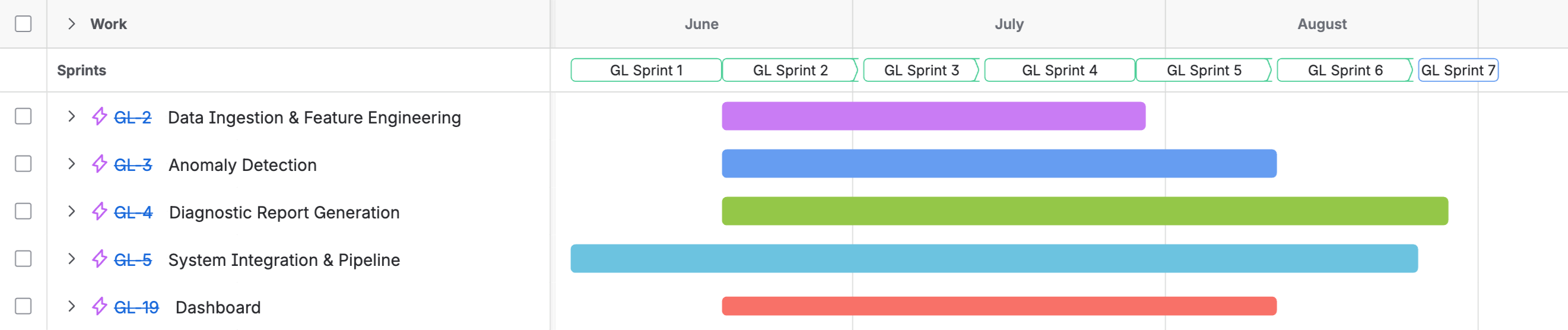
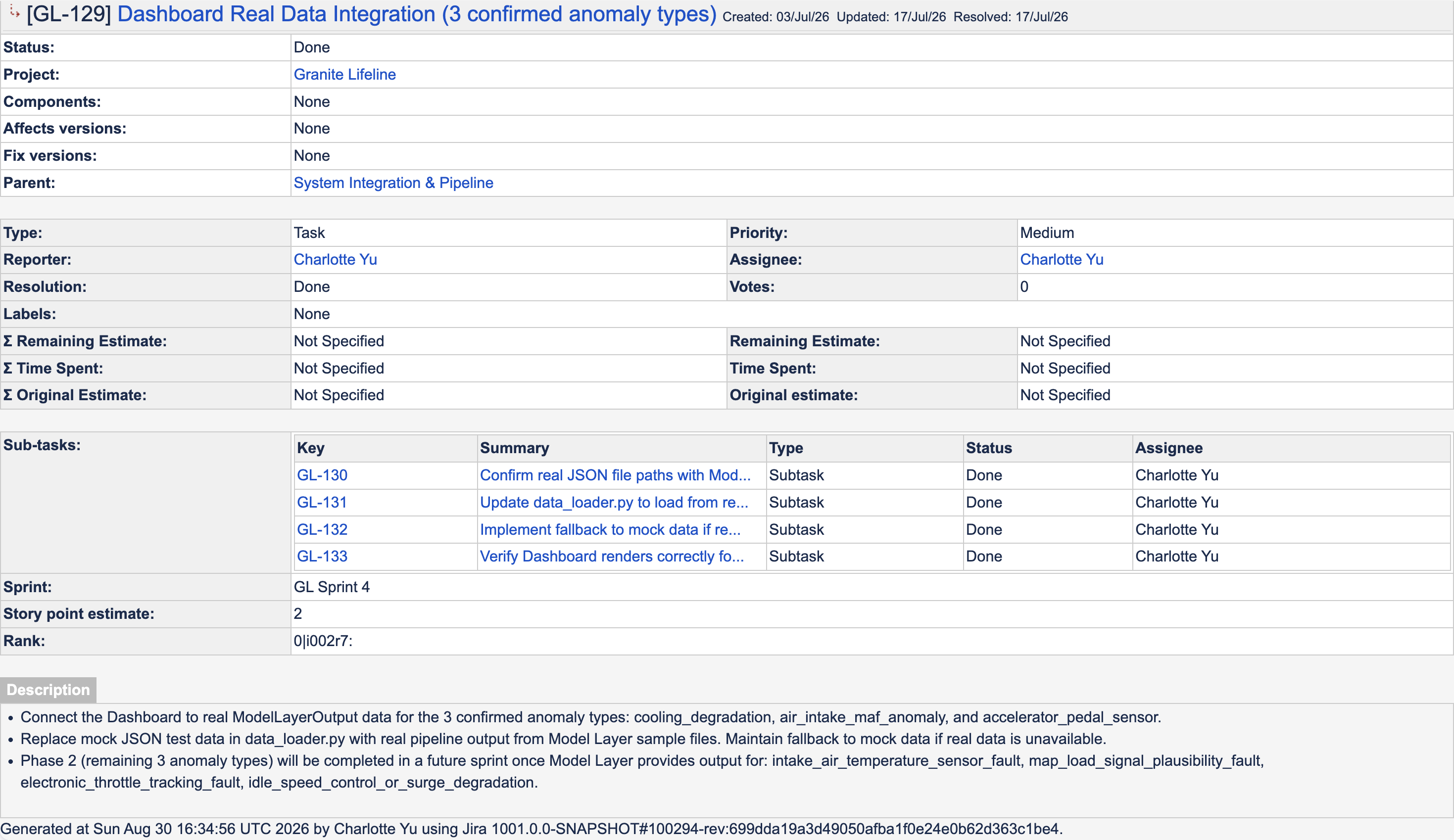
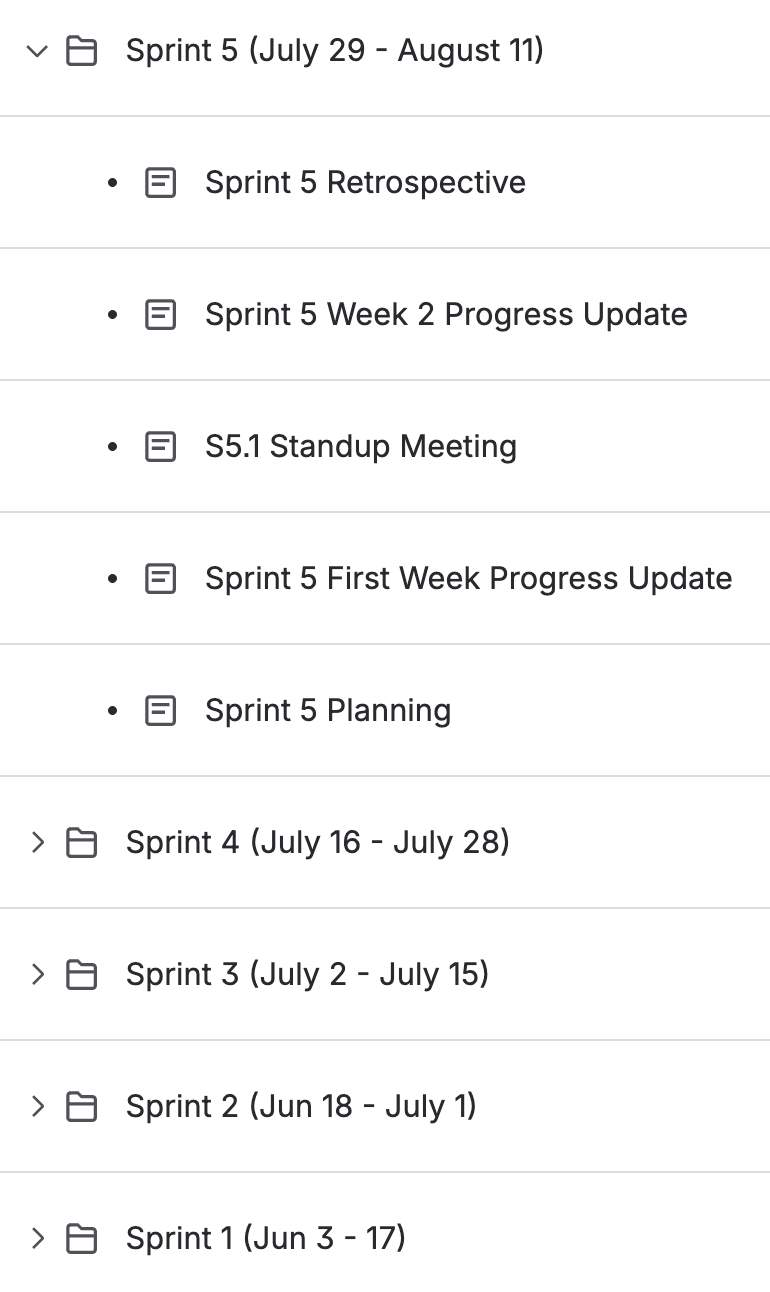
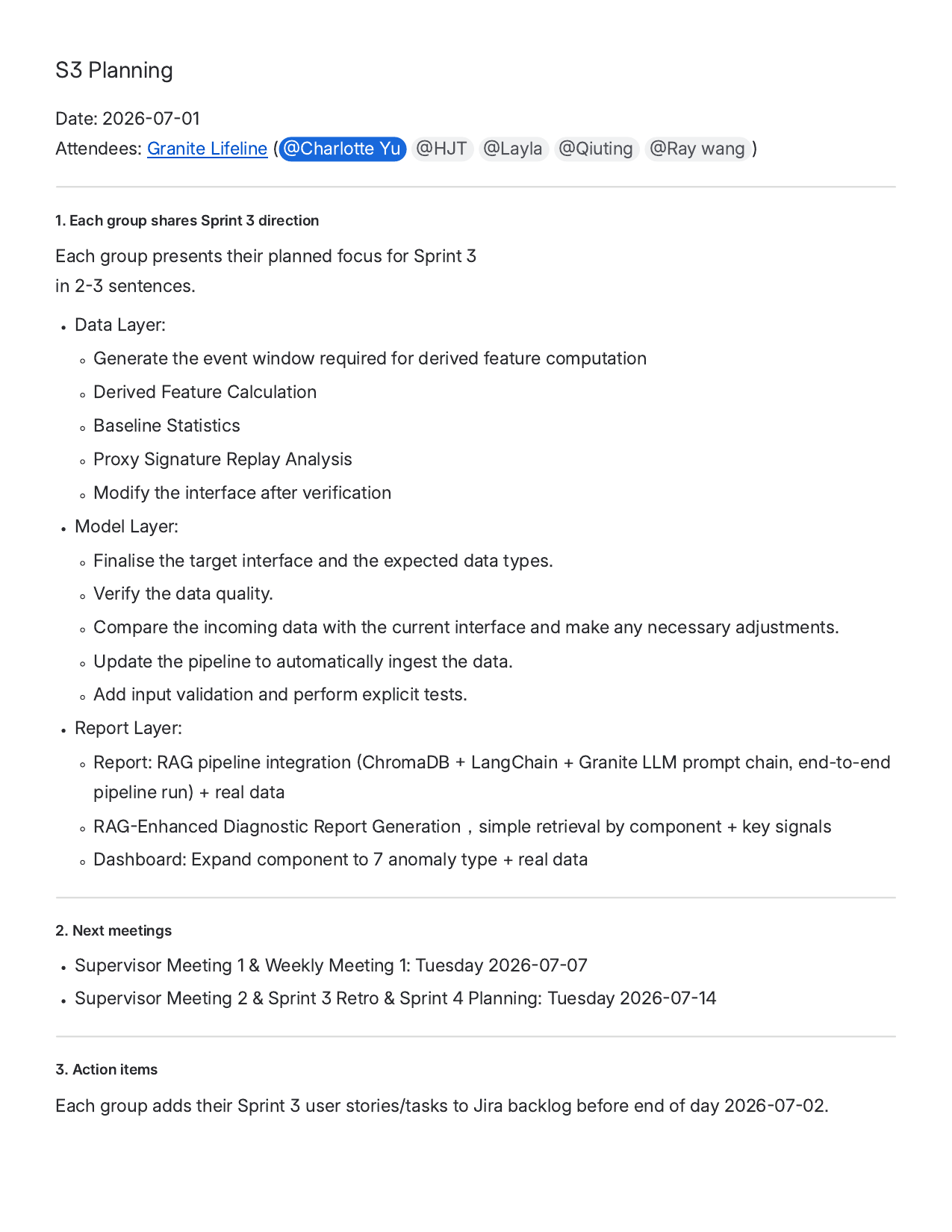
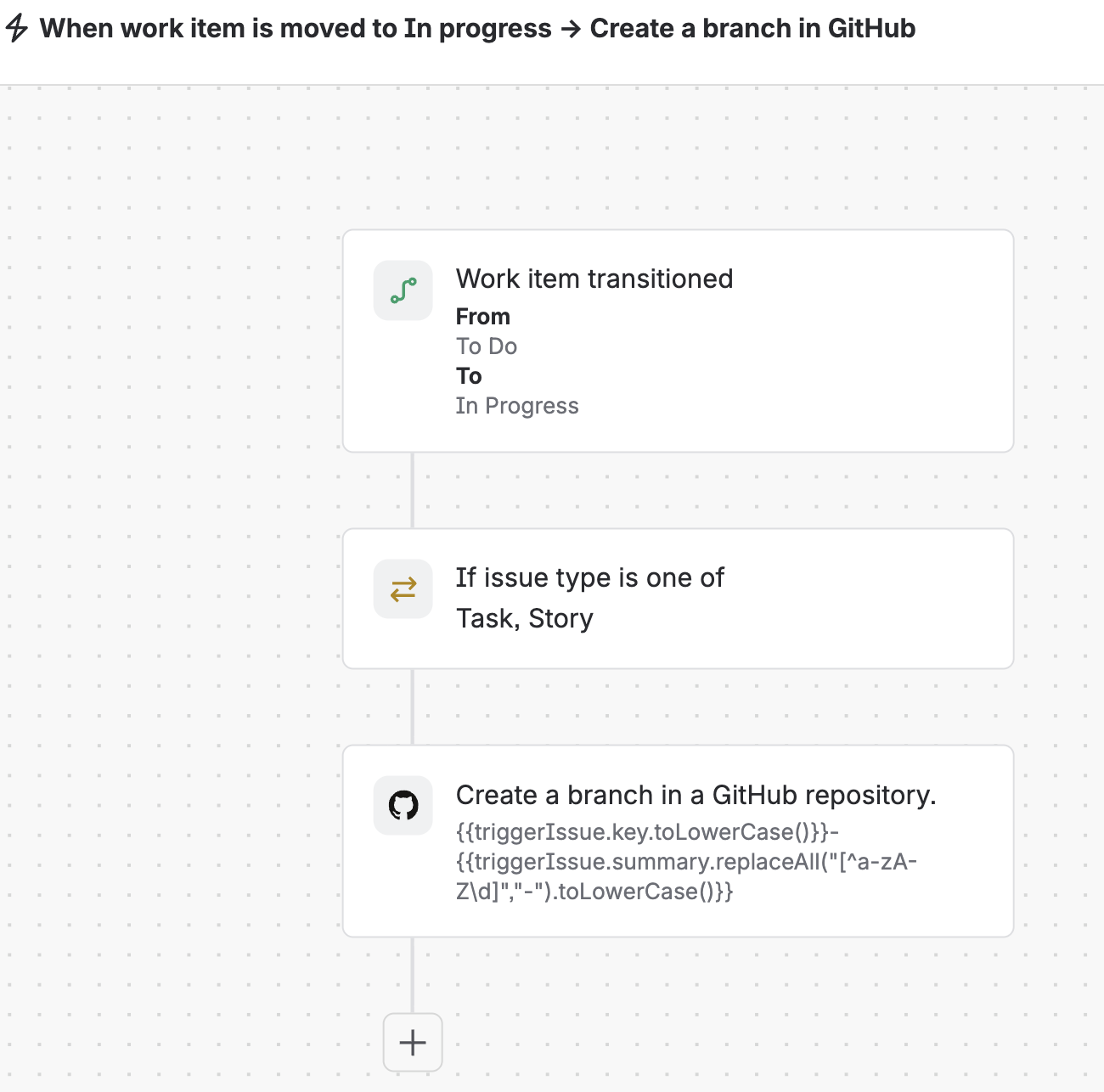
develop.The automation made progress easier to follow. Acceptance criteria, review and tests still determined whether the work was complete.
develop or mainuv cache and install uv.lock.py_compile then flake8Find syntax errors, style problems and common code issues.pytest -m "not model_download"Run the core suite without external model downloads.pytest -m model_downloadCheck the real Hugging Face download path. Failure warns but does not block unrelated work.
Shared interfaces allowed each group to develop against the same field definitions before the complete pipeline was connected.
Reject recordings that cannot satisfy the Data or Model contract before expensive processing begins, then preserve every accepted run as a traceable set of artefacts.
no_usable_segment is raised (run kept for inspection).| Intake rejection code | Triggered when |
|---|---|
bad_filename | The recording date cannot be recovered from the file name. |
missing_columns | The CSV does not carry the required KIT source columns. |
too_few_rows | Fewer than 700 raw rows, or under 700 seconds of recording. |
unreadable_csv | The file cannot be parsed as CSV at all. |
duplicate_upload_filenames | A multi-file upload history repeats the same KIT file name. |
segment_id, so it is judged after the pipeline runs (see the last flow step above), not before.data_layer/pipeline_data/upload_contract.py :: validate_upload_csv(), validate_usable_segment()data_layer/run_pipeline.py :: run_data_pipeline_for_upload(), run_data_pipeline_for_uploads()data_layer/pipeline_data/paths.py :: RunLayout117 selected Data contract tests passed in 9.46sTurn irregular OBD-II recordings into 1 Hz evidence without inventing continuity across missing time, invalid samples or recording boundaries.
| Rule | Threshold / behaviour |
|---|---|
| New segment | Raw timestamp gap >3 s starts a new segment_id. |
| Short-gap fill | Gaps of ≤2 s are filled on the 1 Hz grid; longer gaps are left missing, never bridged. |
| Hard-invalid values | Outside physical bounds → set to missing, but flagged (had_hard_invalid_source). |
| Suspicious values | Physically possible but unusual → kept as-is, flagged (is_suspicious); never silently rewritten. |
| Cross-field checks | Flags contradictions, e.g. RPM=0 with speed>0, MAF=0 with RPM>0, sub-zero coolant in warm ambient. |
| Identity | Breaks when | Granularity |
|---|---|---|
trip_id | Never breaks within one source file. | Coarsest — file-level provenance. |
segment_id | Raw timestamp gap >3 s — a genuine recording break. | Medium — “was recording paused or restarted”. |
continuity_block_id | Not a D1 output — computed on demand by downstream feature-engineering (D3) and proxy (D4) scripts, each with its own required-valid-signal set. Breaks whenever any row in that set fails the quality-valid mask (missing / imputed / suspicious / hard-invalid) or the row/timestamp is not perfectly consecutive — on both sides, even with no time gap at all. | Finest, but caller-dependent — no single block count for the whole corpus. |
continuity_block_id, the strictest of the three identities.data_layer/data_cleaning/src/cleaning_core.pydata_layer/pipeline_data/continuity.py :: build_quality_valid_mask(), build_continuity_blocks()data_layer/data_cleaning/src/cleaning_config.yaml (v3.0)Give every 1 Hz sample physically meaningful context, so normal warm-up, idle and high-load behaviour are not mistaken for faults—and real deviations are not hidden by global averages.
| Thermal state (parent) | Determined by |
|---|---|
engine_off | RPM <50. |
warmup | Engine on, post-warmup condition not yet met. |
post_warmup | Engine on, coolant ≥75°C, plus hot-idle RPM <850, cumulative intake air ≥1,500 g, or IAT−ambient >8°C. |
unknown | RPM missing; forward-filled from the prior state within the same segment. |
| Child state (kinematic) | Determined by |
|---|---|
idle | Speed <1 km/h and |acceleration| <0.15 m/s². |
high_load | Moving and VSP ≥20 kW/t or acceleration ≥1.2 m/s². |
acceleration | Moving, acceleration ≥0.15 m/s², not already high load. |
deceleration | Moving, acceleration ≤−0.15 m/s², not already high load or accelerating. |
steady_driving | Moving, none of the above conditions met. |
post_warmup itself is inferred, not measured: the dataset has no catalyst-temperature channel, so coolant ≥75°C plus one corroborating signal (hot idle, cumulative intake air, or IAT−ambient heat soak) stands in for true catalyst warm-up.data_layer/operating_condition_statistics/src/operating_condition_analysis.py :: add_operating_conditions(), build_counts(), build_rules()Outputs: operating_condition_enriched.csv, operating_condition_counts_overall.csv, operating_condition_signal_summary.csv, operating_condition_rules.csvdocs/adr/102-operating-condition-stratification.mdConvert governed 1 Hz evidence into one deterministic, versioned Data–Model handoff whose fields, order, ownership and provenance cannot drift silently.
| Layer | What it computes | Why kept separate |
|---|---|---|
| B1a · Atomic (8) | Per-row deterministic values: segment gap, engine state, thermal deltas, pedal/RPM slopes. | Cheapest tier — no calibration input, no cross-row window state. |
| B1b · Calibrated residuals (2) | Deviation from an offline physics baseline: speed-density MAF residual, pedal-mapping residual. | Depends on the frozen calibration registry — a separately audited failure surface. |
| B2 · Engine-start context (6) | Facts about the most recent engine start: episode ID, elapsed time, starting ECT/AAT/IAT. | Needs its own episode-boundary logic, distinct from per-row or windowed builders. |
| B3 · Window features (8) | 60–180 s rolling aggregates: MAF integral, ECT rate, intake stability, rolling std-devs, MAP range. | Gated on continuity blocks — a window can never be built across an invalid or discontinuous stretch. |
feature_schema.v1, v1.2.0). Unexpected columns are rejected, key order and dtypes are validated, and the assembler performs no imputation: missingness stays visible rather than being silently filled. A new feature requires an explicit contract/version change, so it can never appear silently in the production CSV.data_layer/contracts/feature_manifest.v1.jsondata_layer/feature_engineering/src/00_input_contract_validator.py, 10_atomic_feature_builder.py, 20_engine_start_context_builder.py, 30_window_feature_builder.py, 40_calibrated_feature_builder.py, 41_production_feature_assembler.pyOutputs: features/41_production/production_features.csv, production_features_manifest.jsonScreen physically plausible fault symptoms into a deliberately small set of runtime checks, preserving the difference between a verdict, supporting evidence, a pending precursor and a design that was never executable.
| Stage | What it does |
|---|---|
| 50 · Rule state | Checks each sub-check's guards/thresholds against the frozen calibration baseline; produces per-row eligibility and raw rule evidence. |
| 60 · Event evidence | Detects driver-demand pedal-step events, for the one sub-check (5-S1) that needs a transient trigger. |
| 61 · Duration evidence | Builds bounded persistence episodes from Stage 50's rule state, for every sub-check whose verdict depends on a sustained condition. |
| 70 · Decision | Reads only Stages 50/60/61 — never the raw feature table again. Assigns decision_role (verdict / pending_precursor / support / arbitration_evidence) and result_state (pass / triggered / not_evaluable / pending), attributes a candidate DTC and whether it is actually emitted, and records confidence, margin and calibration version. Writes proxy_decisions.csv — the artefact handed to the Model layer. |
verdict row with dtc_emitted=true actually authorises a code, and support/arbitration rows always carry dtc_emitted=false. not_evaluable means a live check lacked a valid opportunity, not that a rejected design ran. These are controlled proxy-screening decisions, not confirmed real faults — ADR 201 keeps the Model layer from training on them as ground truth.data_layer/proxy_failure/src/50_rule_state_builder.py, 60_event_evidence_builder.py, 61_duration_evidence_builder.py, 70_proxy_decision_builder.pyproxy_failure_definition.md (authoritative) · proxy_support.md (research companion) · calibration_registry.v1.json (frozen baseline)Outputs: proxy/70_decisions/proxy_decisions.csv, proxy_decision_manifest.jsondocs/adr/103-proxy-screening-and-theoretical-basis.mdKeep the baseline reference fixed: user uploads may apply approved transformations, but can never redefine “normal” by fitting on the vehicle currently being diagnosed.
| Invariant | What it guarantees |
|---|---|
| Offline-only fitting | Online scripts 00–70 forbid fitting, quantile search and threshold selection (online_fit_paths_forbidden=true; Script 40 exposes no fit function) — a slowly failing upload can never teach the system its own decline is "normal". |
| Frozen 66-trip reference cohort | Every proxy family (cooling, MAF, MAP, pedal, intake temperature) calibrates against the same fixed cohort_trip_count: 66 cohort — no family cherry-picks its own subset. |
| SHA-256 checksum binding | Registry (calibration_registry.v1.json) and feature-manifest checksums are embedded and verified before online use; Script 40 fails closed on any drift. |
| Null on invalid input | Quality-invalid required inputs yield null residuals rather than a fabricated estimate. |
recalibrate_20260723) proves the frozen release can be reproduced from its declared evidence within tolerance. It does not prove the calibration generalises to every make, engine or sensor package — broader external-vehicle validation remains future work.data_layer/calibration/calibration_registry.v1.json, calibration_registry.v1.manifest.jsondata_layer/feature_engineering/src/90_calibration_registry_builder.py :: run_calibration_audit()data_layer/feature_engineering/src/40_calibrated_feature_builder.py :: _validate_release_bundle(), build_calibrated_features()calibration_audit_manifest.json — 48 PASS / 0 FAILChallenge every executable proxy end to end with paired, single-signal interventions—testing severity response, independent contexts and diagnostic semantics without claiming synthetic detection is field recall.
| Design factor | Value / rule |
|---|---|
| Severities | 3 ordered levels (mild / moderate / strong); detection rate must not decrease as severity rises. |
| Independent trips per severity | 3, so one favourable trip can't be counted as independent evidence. |
| Scoped observations | 14 cases × 3 severities × 3 trips = 126. |
| Unique injected runs | 42 — one copied run hosts all 3 severity points for a case/trip. |
| Acceptance rule | Per case curve, not per observation: non-decreasing detection rate, ≥0.8 at strongest severity, and the equivalent baseline must not already be positive. |
data_layer/fault_injection/configs/fault_injection_cases.v1.jsondata_layer/fault_injection/src/run_fault_injection.pyOutputs: fault_injection_summary_20260903T051231Z.csv/.jsontest_fault_injection_campaign.pyHand Model both sample-grain forecasting evidence and decision-grain proxy evidence from the same isolated run, while preserving their different meanings, consumers and claim boundaries.
production_features.csv for forecasting and context.proxy_decisions.csv for governed verdict forwarding and evaluation.| Boundary question | A · production_features.csv | B · proxy_decisions.csv |
|---|---|---|
| Upstream input | Stage 41 reads only the four feature-family tables (10/20/30/40), joined on identical sample keys. | Stage 70 reads only Stages 50/60/61's evidence outputs plus the frozen calibration registry — never the raw feature table again. |
| Format | CSV, sample grain — one row per 1 Hz sample, exact 46 ordered columns (DataLayerOutput contract). | CSV, decision grain — one row per sub-check × evaluation unit. |
| Required fields | Every column is a required key — nullable fields stay as required keys rather than being dropped. | trip_id, segment_id (nullable), evidence start/end timestamps, decision_role, result_state, dtc_candidate_label, dtc_emitted, margin, confidence, calibration version. |
| Can Data redefine field meaning here? | No — Stage 41 only joins already-computed fields verbatim, with strict type/order checks. | No — Stage 70 only routes existing evidence into a decision; it doesn't redefine what the evidence means. |
| Invalid / missing input | No imputation at the interface — missingness stays visible through explicit null semantics rather than being silently filled. | not_evaluable when a live check lacks a valid opportunity — never forced into pass or triggered. |
| What Model (next layer) receives | 512-context / 96-forecast windows and residual scoring — measurement/features, not a diagnostic conclusion. | Governed verdict forwarding and evaluation/filtering — must not be merged column-by-column into the 46-column feature table (different cardinality). |
| Tests covering this boundary | Field contract: valid/optional/nullable fields, missing required field, wrong type. | Decision semantics: role/result/DTC attribution. Shared with A: both deliveries come from one run (default stops at 41, proxy stages opt-in, all stages share one run). |
data_layer/run_pipeline.py :: run_data_pipeline(), run_data_pipeline_for_upload()shared/interface_models.py :: DataLayerOutputtests/test_interface.py, data_layer/tests/proxy_test/test_70_proxy_decisions.py, data_layer/tests/pipeline_data_test/test_public_pipeline_contract.pydocs/INTERFACE.md v1.3–v1.4The model only forecasts when the input data is complete, valid and continuous.
model_layer/ttm-related/src/model/input_validation.pymodel_layer/ttm-related/src/model/kit_residual_detector.py::select_segment()model_layer/ttm-related/src/model/prepare_finetune_split.pyTTM learns normal driving patterns without using fault labels.
| Approach | Training target | Decision |
|---|---|---|
| Fault classifier | Needs verified examples of each fault | Not used: the dataset has no confirmed fault labels. |
| TTM forecasting | Normal signal behaviour | Selected: no proxy type or DTC is used as a target. |
Using the same proxy rules for training and testing would mean that the rules created both the training answers and the test answers.
Rules are added after the forecast to help explain the result. They are not TTM training labels.
model_layer/ttm-related/src/model/kit_residual_detector.py::run_ttm_forecast()model_layer/ttm-related/src/model/finetune_ttm.pydocs/adr/201-residual-detection-over-classification.mdWe turn forecast errors into risk scores and rank the five supported fault types.
| Fault type | Result comes from | Main evidence |
|---|---|---|
| Cooling degradation | Model Layer | Forecast error + temperature checks |
| Reduced airflow | Model Layer | Forecast error + airflow checks |
| Accelerator pedal | Model Layer | Forecast result + pedal agreement |
| IAT sensor fault | Data Layer | No response, stuck signal and cold start |
| MAP/load plausibility | Data Layer | MAP and MAF disagreement |
The highest score is the main candidate, not a diagnosis. The second candidate appears in secondary_risk.
Only the top two are shown; real multi-fault cases were not available.
A risk score of 0.8 means strong unusual modelled behaviour. It does not mean an 80% probability of mechanical failure.
For Model results, confidence measures how stable the forecast errors are. It is not diagnostic probability.
Data results keep confidence values of 0.9, 0.6 or 0.35.
Emitted DTC: 0.9 · triggered rule: 0.6 · supporting evidence: 0.5 · otherwise: 0.
model_layer/ttm-related/src/model/kit_residual_detector.py::calculate_residuals()model_layer/ttm-related/src/model/kit_residual_detector.py::calculate_ranked_risks()model_layer/ttm-related/src/model/proxy_decision_forwarding.pyshared/interface_models.py::ModelLayerOutputWe trained on normal driving data and selected one final model for evaluation and runtime use.
| Model setup | Observed result | Final use |
|---|---|---|
| Original pretrained TTM | Comparison starting point | Comparison only |
| Epoch-five fine-tuned TTM | 5.23% lower forecast MAE on 250 validation windows | Selected for evaluation and runtime |
| Signal-mixing version | Overall MAE worsened from 54.9666 to 55.6532 | Rejected |
The model must learn normal behaviour. Training on faults could teach it to predict the fault and make the forecast error smaller.
MAP MAE changed from 21.63 to 21.66. Relationships with other signals may explain this, but the project did not prove the cause.
OFFICIAL_DETECTOR_MODEL_PATH.model_layer/ttm-related/src/model/finetune_ttm.pymodel_layer/ttm-related/src/model/compare_finetune_residuals.pymodel_layer/ttm-related/outputs/finetune_residual_comparison_e5_lr5e-5.jsonWe tested artificial faults, measured each fault type separately and set a threshold to limit false alarms.
| Fault type | Measured result | What it tells us |
|---|---|---|
| Cooling | Recall 1.0000 | Artificial cooling changes were caught consistently. |
| Accelerator pedal | Precision 1.0000 · recall 0.3247 | Few false positives, but many injected cases were missed. |
| MAF / airflow | Precision 0.2000 · recall 0.0455 | Only 2 of 44 artificial cases were detected correctly. |
| Threshold stage | Normal-data alarms | Decision |
|---|---|---|
| Before calibration | 3 of 11 | Too many false alarms |
| Selected threshold: 0.4129 | 1 of 11 | Best macro F1 with false alarms ≤10% |
| High-risk threshold: 0.9 | — | Unchanged |
model_layer/ttm-related/src/model/fault_injection.pymodel_layer/ttm-related/src/model/risk_threshold_calibration.pymodel_layer/ttm-related/src/model/run_synthetic_evaluation.pymodel_layer/ttm-related/outputs/synthetic_eval_metrics_e5_lr5e-5_calibrated.jsonWe use risk scores from several trips to estimate when the score may reach 0.9. This is not a failure prediction.
The estimated chance that this detector's risk score reaches 0.9 within ten trips.
The probability that the vehicle or component will mechanically fail.
model_layer/ttm-related/src/model/failure_estimation.py::estimate_from_history()model_layer/ttm-related/src/model/risk_history.pyreport_layer/evaluation/viva_real_caseA fixed interface passes Model results to Dashboard and stops when the files do not match.
| Input state | Model response |
|---|---|
| Wrong columns, sampling rate or version | Stop and return one clear ERROR: message. |
| No continuous 700-row section | Stop without producing a risk result. |
| Valid input | Return the highest-risk summary and every analysed window. |
A historical °C/s versus °C/min mismatch changed values by 60 times.
P0116 and P0128 were moved to the correct cooling owner.
dashboard/csv_pipeline.pymodel_layer/ttm-related/src/model/kit_residual_detector.pymodel_layer/ttm-related/src/model/validate_output.pyshared/interface_models.pyThis is an offline research system, not a confirmed diagnostic tool for real vehicles.
| Evidence supports | Evidence does not support |
|---|---|
| Response to artificial faults | Accuracy on real breakdowns |
| Risk trends across recorded trips | Mechanical-failure probability or remaining useful life |
| Proxy-rule evidence | A confirmed diagnosis |
| Offline pipeline behaviour | Readiness for live vehicle deployment |
Artificial-fault tests and normal-driving risk histories from one vehicle dataset.
None of the 81 normal-driving trips contains a confirmed fault, repair result or failure event.
model_layer/ttm-related/src/model/fault_injection.pymodel_layer/ttm-related/src/model/run_synthetic_evaluation.pymodel_layer/ttm-related/src/model/kit_residual_detector.pyreport_layer/evaluation/viva_real_caseConvert Model's machine-oriented object into a stable evidence brief that Granite can read—without asking the LLM to recalculate abnormality, reinterpret units or turn data-quality notes into mechanical causes.
coolant_temp and speed_density_maf_residual to readable labels.risk_history, while generation uses the validated worst-risk summary.context_injection.py: build_context(), build_context_with_rag(), display names and correlation maps.report_generator.py: _extract_summary_payload() and _extract_risk_history_payload().shared/interface_models.py: the initial shared Pydantic contract and later cross-layer alignment.Retrieve only the fault explanation and action tier relevant to the known anomaly and current risk, grounding Granite in source-backed domain knowledge without exposing it to unrelated or over-urgent instructions.
fault_knowledge: 5 types × 4 sections = 20 documents.symptom_knowledge: 5 types × one merged document = 5 documents; retained for comparison.description_causes, actions_low, actions_medium, actions_high.electronic_throttle_tracking_fault failed semantic retrieval under both chunking strategies.knowledge_indexer.py: create_documents_for_anomaly(), index_knowledge_base().symptom_knowledge_indexer.py: merged-document comparison collection.rag_retriever.py::retrieve_all() and context_injection.py::build_context_with_rag().retrieval_comparison.md preserves the historical 7-type experiment; current code truth is five types and 20/5 documents.Generate the owner-facing report in three dependent, narrowly scoped steps so observed evidence, possible explanation and recommended action remain distinguishable—and so only the action layer receives risk-specific maintenance guidance.
non-technical vehicle owner.prompts/layer1_description.txt, layer2_cause.txt, layer3_action.txt: current roles, tasks, constraints, edge cases and JSON contracts.report_generator.py::_correct_and_validate_layer() connects validation and one targeted correction.prompt_chain_validator.py::validate_layer1(), validate_layer2(), validate_layer3().Run the three dependent local-LLM calls defensively: accept parseable field-level JSON, retry transient or malformed responses, and preserve Model evidence in a schema-shaped fallback instead of crashing the Dashboard pipeline.
extract_json() first uses json.loads(response), then extracts an embedded outer object as a repair attempt._build_empty_report() keeps Model scores, signals, estimates, notes and risk history.report_generator.py::generate_report(): outer non-raising boundary and sequential layer loops.extract_json(), call_ollama(), _build_empty_report().tests/test_report_generator.py: success, timeout, malformed JSON, invalid input and pass-through preservation on success/fallback; 6 tests passed in 0.30 s with HTTP mocked rather than a live Ollama dependency.Hold the generation pipeline constant, vary only the knowledge supplied to the prompts, and inspect what retrieval changes across all five current anomaly types.
coolant_temp, losing 0.30 Readability.SIGNAL_DISPLAY_NAMES so future context uses “coolant temperature” rather than raw schema names; prompt rules were also tightened.confirmed.report_quality_evaluator.py::evaluate_factual_grounding(), evaluate_readability(), evaluate_hedging_appropriateness(), evaluate_actionability(), evaluate_report().rag_baseline_comparison_table.md: exact scenario and aggregate scores plus manual interpretation.rag_evaluation_criteria.md: Huang/Qi/ADR 302 grounding and >0.7 quality threshold.Package machine evidence and owner-facing language in one shared shape: Model facts pass through unchanged, batch-window risk becomes request-local chart history, and Granite adds exactly three narrative fields.
risk_history distilled from the current batch's windows.timestamp, risk_score, risk_level, component, prediction_confidence, key_signals, two nullable estimate fields and notes.risk_history: [{timestamp, risk_score}] | null.anomaly_description: string, possible_cause: string, recommended_action: string[].ReportLayerOutput constrains component enum and 0–1 score/probability ranges.report_generation_success flag exists; Dashboard must infer unavailable narrative from empty fields.ReportLayerOutput; strict final validation is a documented hardening opportunity.summary supplies the report's single-window facts._extract_risk_history_payload() scans windows and keeps entries containing both timestamp and risk score.secondary_risk appearances.explanation_text with three report fields and structured key signals.estimated_cycles_to_failure, estimated_failure_probability and notes through Report and Dashboard-facing contracts.shared/interface_models.py::ReportLayerOutput and RiskHistoryEntry.report_generator.py::_extract_risk_history_payload(), _build_empty_report(), generate_report().docs/INTERFACE.md §3.1–3.3 and v1.5 change history.tests/test_report_generator.py verifies pass-through preservation on both success and fallback.Four locally runnable Granite models were compared on the same Cooling case and the same three-call sequence.
| Criterion | Weight | 3.3 2B | 3.3 8B | 4.1 3B | 4.1 8B |
|---|---|---|---|---|---|
| Plain language | 30% | 3 | 4 | 4 | 5 |
| Grounding | 25% | 4 | 4 | 4 | 5 |
| Valid JSON | 20% | 2 | 5 | 5 | 5 |
| Action quality | 15% | 3 | 3 | 4 | 5 |
| Uncertainty | 10% | 4 | 4 | 4 | 4 |
| Weighted total | 100% | 3.15 | 4.05 | 4.15 | 4.85 · selected |
The storage method had to keep reviewed knowledge inspectable and select only the part required by the current report section.
| Option | Observed trade-off | Decision |
|---|---|---|
| Full knowledge in every prompt | Unrelated material and unnecessary prompt length | Not used |
| Semantic vector retrieval | Useful when the category is unknown; ranking varied across records | Compared |
| Metadata-filtered ChromaDB | Exact filtering from the anomaly key already supplied by the Model Layer | Selected |
report_layer/rag/grounded_knowledge.yaml is the reviewed source.report_layer/rag/knowledge_indexer.py rebuilds the collection and checks all five anomaly types.knowledge_indexer.py prepares the reviewed YAML for retrieval; rag_retriever.py selects the two records required for the current report.
proxy_failuresRAG is the overall method. This experiment compared two ways of choosing which reviewed record enters a prompt.
| Retrieval method | Correct record | Average time |
|---|---|---|
| Metadata + section | 7/7 | ≈0.34 ms |
| Semantic + section | 4/7 | ≈61.0 ms |
| Metadata + whole document | 7/7 | ≈0.31 ms |
| Semantic + whole document | 6/7 | ≈57.4 ms |
Use fields already supplied by the Model Layer to select one matching record.
collection.get(where={"$and": [
  {"anomaly_type": {"$eq": anomaly_type}},
  {"section": {"$eq": "actions"}},
  {"risk_level": {"$eq": risk_level}}
]})Embed a symptom description and rank records by similarity, even when their wording differs.
collection.query(
  query_texts=[symptom_description],
  n_results=1
)
One Medium-risk Cooling case is used through the next three cards to show what the Report Layer receives and what it may explain.
cooling_degradationestimated_cycles_to_failure = 5
Projected trips until the risk trend reaches the High threshold.
estimated_failure_probability = 0.7502
Chance of crossing High within the fixed next ten trips.
ModelLayerOutput(**summary) triggers these Pydantic rules before retrieval or any Granite call begins.
report_layer/pipeline/report_generator.py: validated = ModelLayerOutput(**summary_payload) → only the validated object is passed to build_context_with_rag(validated).AnomalyType = Literal[ "cooling_degradation", "air_intake_maf_anomaly", "accelerator_pedal_sensor", "intake_air_temperature_sensor_fault", "map_load_signal_plausibility_fault" ] RiskLevel = Literal["Low", "Medium", "High"] class ComponentRiskOutput(BaseModel): timestamp: str anomaly_type: AnomalyType risk_score: float component: AnomalyType prediction_confidence: float key_signals: List[KeySignal] estimated_cycles_to_failure: Optional[int] = Field(...) estimated_failure_probability: Optional[float] = Field(...)
@field_validator(
  "risk_score",
  "prediction_confidence"
)
def _score_in_unit_range(value):
  if not 0 <= value <= 1:
    raise ValueError(...)

@field_validator(
  "estimated_failure_probability"
)
def _failure_probability_in_unit_range(value):
  if value is not None and not 0 <= value <= 1:
    raise ValueError(...)

@field_validator("reference_range")
def _reference_range_has_two_values(value):
  if len(value) != 2:
raise ValueError(...)@model_validator(mode="after")
def _component_mirrors_anomaly_type(self):
if self.component != self.anomaly_type:
raise ValueError(...)
@model_validator(mode="after")
def _secondary_risk_is_distinct_and_ranked(self):
secondary = self.secondary_risk
if secondary is None:
return self
if secondary.anomaly_type == self.anomaly_type:
raise ValueError(...)
if secondary.risk_score > self.risk_score:
raise ValueError(...)Technical fields are converted into a short evidence summary while their values and meanings remain unchanged.
coolant_temp → coolant temperature.# Abridged from build_context_with_rag()
context = build_context(ttm_output)
risk = ttm_output.risk_level.lower()
rag_knowledge = retrieve_all(
anomaly_type=ttm_output.anomaly_type,
risk_level=risk,
)
# R7 applies the signal-relevance gate here.
return {
"context": context,
"fault_knowledge": fault_knowledge,
"actions_knowledge": actions_knowledge,
}report_layer/pipeline/context_injection.py prepares the context.Retrieval finds category-matched material; an additional check decides whether its explanation fits the direction of the current signals.
Each Call has a separate question, evidence allowance and output contract.
Prepared Model fields only.
Example“Coolant temperature is low while warming faster than expected.”
Accepted Call 1 + admitted cause knowledge.
Example“This pattern may relate to sensing or coolant circulation.”
Risk state + role-separated action knowledge.
Example“Arrange an inspection and report the two readings to the mechanic.”
| Call | Fixed boundary | Output |
|---|---|---|
| 1 | No diagnosis or retrieved cause | Observed pattern |
| 2 | Possible causes remain conditional | Explanation |
| 3 | Technical procedures assigned to mechanic | Now · timing · stop conditions · mechanic information |
A specific number in an early few-shot example appeared in a new report even though it was absent from that report’s Model input.
Failure-threshold probability: 1.0
Estimated trips: 4
No value of 0.31% was supplied.
An unrelated accelerator-pedal example contained the illustrative value 0.31%.
Each accepted section becomes part of the next prompt. A failed section is corrected before generation continues.
Model evidence and prepared context.
Clean → validate → one correction if required
Model evidence + accepted Call 1 + cause knowledge.
Clean → validate → one correction if required
Model evidence + accepted Calls 1–2 + action knowledge.
Clean → validate → one correction if required
Call 2 receives the accepted observation. Call 3 receives both accepted earlier sections. Each Call also keeps access to the relevant Model evidence.
After Call 3 passes, the complete cleaned chain is checked once more. Release follows only when all three sections score at least 0.80; otherwise the report uses the fallback path.
The same validation framework selects rules for the section, scores the result and returns exact warnings for one correction attempt.
Start at 1.00 · release at 0.80 or above
“coolant_temp is high and the cooling fan has failed.”
Warnings identify the raw field, unsupported direction and confirmed-fault wording.
The correction prompt receives the original task, rejected JSON and exact warnings. Only this section is regenerated and checked again.
The pipeline treats a failed model request differently from a readable JSON response that breaks a report rule.
The final evaluation changed only the knowledge supplied to Granite while keeping the model, prompts, temperature, inputs and Validator fixed.
| Condition | Knowledge supplied | Purpose |
|---|---|---|
| No retrieved knowledge | Model context only | Generation baseline |
| Cause knowledge | Reviewed descriptions and possible causes | Test explanation grounding |
| Cause + raw workshop actions | Cause records and unseparated procedures | Expose audience/action-role problems |
| Cause + role-separated actions | Owner observations, timing and stop conditions separated from mechanic procedures | Final design |
What to observe now, when to arrange service, and which visible warning signs require urgent help.
Scan-tool checks, wiring inspection, calibration and replacement decisions are presented as requests for a qualified mechanic.
The same 20 reports produced machine-checkable results and separate human judgements about meaning and audience.
| Condition | Released | Valid structure | No unsupported numbers | No unsafe owner procedure detected | Fallback |
|---|---|---|---|---|---|
| Controlled baseline | 5/5 | 5/5 | 5/5 | 5/5 | 0/5 |
| Cause RAG | 5/5 | 5/5 | 5/5 | 5/5 | 0/5 |
| Cause + raw actions | 5/5 | 5/5 | 5/5 | 5/5 | 0/5 |
| Cause + role-separated actions | 5/5 | 5/5 | 5/5 | 5/5 | 0/5 |
| Condition | Input faithfulness | Retrieval relevance | Knowledge use | Audience | Action safety | Uncertainty |
|---|---|---|---|---|---|---|
| Controlled baseline | 5 pass | N/A | N/A | 5 pass | 5 pass | 5 pass |
| Cause RAG | 5 pass | 4 pass · 1 partial | 1 pass · 4 partial | 3 pass · 2 partial | 5 pass | 5 pass |
| Cause + raw actions | 5 pass | 4 pass · 1 partial | 1 pass · 4 partial | 3 pass · 2 partial | 5 pass | 5 pass |
| Cause + role-separated actions | 5 pass | 4 pass · 1 partial | 1 pass · 4 partial | 3 pass · 2 partial | 5 pass | 5 pass |
| Where did manual review record partial? | Reason |
|---|---|
| Retrieval relevance · IAT | The record matched the intake-temperature category, but all displayed temperatures were within range. The current evidence could not show whether a circuit issue or a connector issue better matched this case. |
| Knowledge use · MAF, pedal, IAT and MAP | Retrieved knowledge added several plausible causes, but the current signals did not contain enough evidence to choose which cause best matched the case. Cooling was the only full pass. |
| Audience · MAF and IAT | The reports respected the evidence and action boundaries, but their cause explanations remained longer and more technical than ideal for a non-specialist reader. |
Start with an explicit choice: analyse uploaded OBD-II data or explore a labelled demonstration.
| Source | Meaning |
|---|---|
| uploaded / uploaded_history | Results from a live single-upload or joint-history request. |
| real | Real-source output identified by the loader. |
| mock | Demonstration values; not evidence of a live run. |
| missing | No available component data. |
_data_source map carries provenance. Demo/missing warnings prevent silent substitution; accepted uploads override static data within the active session.dashboard/data_store.py: session result → cached static data → emergency fallback; static path can be set through DASHBOARD_TEST_DATA.dashboard/data_loader.py: source map and real/mock loading. GL-85 → GL-129/131 → GL-132/133 established source-aware integration.Live analysis relies on local Model dependencies and Ollama; installation remains a barrier for non-technical owners.
Python, the Model environment, Ollama and Granite must be available. The hosted demonstration uses static results.
Package the application or provide a hosted inference service so owners can upload data without terminal setup.
| Decision | Reason / trade-off |
|---|---|
| Model batch subprocess | Uses the published CLI and isolates pinned Torch/Transformers dependencies; adds process startup and serialization overhead. |
| Interpreter selection | MODEL_LAYER_PYTHON → dedicated Model virtual environment → current Python. |
| Local artefacts | Temporary raw/Model files are cleaned up; Data artefacts persist by run. Retention and privacy handling require further work. |
README.md and dashboard/README.md: live setup and hosted-demo scope.dashboard/csv_pipeline.py::_run_model_layer(): fixed Model working directory and 120-second subprocess timeout.Accepted trips are ordered chronologically and processed together while retaining individual trip boundaries.
uploaded_history label distinguishes the result. This request history is not a persistent cross-session vehicle record.dashboard/csv_pipeline.py::run_uploaded_csv_history_batch() and _run_data_layer_history().Reject unusable files before expensive processing and show the owner a readable reason.
| Check | Behaviour |
|---|---|
| Readable, non-empty CSV | Reject absent bytes, empty data and parsing failures. |
| 11 required raw columns | Validate time, temperature, pressure, RPM, speed, airflow, throttle and pedal fields; accept the known °C/°C header variant. |
| At least 700 rows per admission check | Protect the temporal input requirement; 700 rows is about 11.7 minutes at 1 Hz. UI guidance asks for roughly 15 minutes. |
| Original KIT filename | Preserve the recording-date identity instead of renaming to a generic temporary file. |
| Continuity and usable segments | The Data Layer can still reject a file that passes the initial column/row checks. |
dashboard/csv_validator.py, dashboard/pages/overview.py and dashboard/csv_pipeline.py.Dashboard coordinates the layers and presents their evidence; it does not make a new vehicle prediction.
| Owner | Responsibility |
|---|---|
| Model | Risk score, supplied risk level, attribution confidence, key signals, window history and optional projections. |
| Report | Preserve structured evidence and add anomaly description, possible cause and recommended action. |
| Dashboard | Validate/adapt payloads, select and sort components, draw rings/charts, compare signal ranges and format exports. |
Accept single outputs or batch envelopes; normalise legacy coolant_slope to ect_rate_180s, remove retired coolant_stability and canonicalise component aliases.
PDF offers Summary, Failure Prediction, Risk Trend, Key Signals and Diagnostic Report. CSV offers feature, value, unit, range and status; multiple components can be packaged as ZIP files.
dashboard/data_loader.py: extraction, normalisation and Pydantic validation.dashboard/export_helper.py: missing-value formatting, safe filenames, PDF/CSV and ZIP packaging.Different indicators answer different questions; none is a validated probability of mechanical breakdown.
| Indicator | Meaning |
|---|---|
| Risk score | Model internal anomaly indicator on a 0–1 scale. |
| Risk level | Model-supplied Low, Medium or High category. |
| Prediction confidence | Support for the component attribution; not breakdown probability. |
| Risk Trend | Internal risk scores across recorded analysis windows in the request. |
| Estimated cycles to failure | Projection of trips until the score crosses the High-risk threshold; not physical remaining useful life. |
| Estimated failure probability | Projected chance of crossing that threshold within the prediction horizon; not calibrated mechanical-failure probability. |
shared/interface_models.py, docs/INTERFACE.md, dashboard/pages/detail.py.The Overview prioritises supported components that may need attention.
dashboard/data_store.py::get_overview_components(), dashboard/pages/overview.py and dashboard/anomaly_display.py.Compare each available reading with its supplied reference range and preserve the evidence next to the status.
| Input / result | Interpretation |
|---|---|
| Reading + reference range | Values outside the range are Abnormal; values within it are Normal. |
| Coolant example | 84.0°C and rise rate 5.5069°C/min are shown as abnormal in the viva payload. |
| Supporting normal readings | Vehicle speed 70.0 km/h and manifold pressure 132.0 kPa remain normal. |
| Owner-readable labels | Show signal name, value, unit and range; glossary tooltips explain technical terms. |
dashboard/pages/detail.py::_render_signals(), dashboard/glossary.py and dashboard/export_helper.py.Unavailable evidence remains unavailable instead of becoming an invented measurement or estimate.
| Missing item | Display behaviour |
|---|---|
| Trend | Show an empty/unavailable state when usable history is insufficient. |
| Key signals | Show no available signals rather than fabricated readings. |
| Projection fields | Retain null/unavailable values; do not invent percentages or cycles. |
| Component source | Keep the missing/demo provenance visible. |
| Export values | Normalise missing values explicitly in the portable report. |
dashboard/pages/detail.py, dashboard/data_store.py and dashboard/export_helper.py.A failed generation must not be presented as evidence that the vehicle is healthy.
| Failure | Response |
|---|---|
| Model unavailable / non-zero exit | Show a readable Model error; extract the documented ERROR message when available. |
| Model timeout / invalid output | Handle the 120-second timeout, missing JSON or invalid JSON as pipeline failure. |
| Returned components all have empty descriptions | Treat the returned components as generation failure even when their shape is valid. |
| Recovery | Clear loading state in finally; only accepted results update the Dashboard session. |
dashboard/pages/overview.py::_handle_uploaded_csv_submit(); GL-261 and commit bc50667 document silent-fallback detection.Granite translates structured evidence and reviewed knowledge into owner-facing language, but grounding does not guarantee correctness.
Relevant knowledge and structured facts constrain the explanation. Owner observations are separated from mechanic procedures.
A plausible cause is still a hypothesis. Report checks address specified errors, but cannot prove every explanation matches a real mechanical condition.
report_layer/report_generator.py and the reviewed RAG knowledge; Report backup cards R3–R11.Contract tests, controlled substitutes and saved live runs answer different validation questions.
| Evidence | What it establishes |
|---|---|
| Validation and UI tests | Upload gates, source labels, sorting, missing states, loading recovery, risk display, glossary and report rendering. |
| Controlled pipeline tests | Data/Model handoff, proxy forwarding, timeouts and output contracts without expensive live calls. |
| Export tests | Deterministic PDF/CSV transformation, packaging and formatting. |
| Saved real-case run | The available vehicle data can exercise the integration route; it does not establish accuracy on confirmed breakdowns. |
| Historical Dashboard run | 171 passed, 1 skipped on 2 Aug 2026; a historical snapshot, not a fresh test result. |
dashboard/tests/ and report_layer/evaluation/viva_real_case/.Make risk easier to interpret without suggesting that a clearer interface makes the prediction more accurate.
| Interpretation problem | Interface response |
|---|---|
| Percentage-led visuals can look like breakdown probability | Emphasise Low, Medium and High risk levels while retaining the internal score for visual scale. |
| Risk Score Trend sounds like a probability forecast | Use Risk Trend and explain that the chart represents an internal risk pattern. |
| Technical evidence is difficult to read | Use owner-facing component names, glossary help and what / why / action sections. |
report_layer/evaluation/user_testing_ab/, dashboard/pages/detail.py and dashboard/glossary.py.