Choosing Our Granite LLM: How We Evaluated Four Models for Diagnostic Report Generation
What We Were Trying to Solve
Granite Lifeline generates plain-English diagnostic reports for vehicle owners using IBM Granite LLM. The report layer takes anomaly detection output from IBM Granite TTM and produces three sections: what is happening, why it might be happening, and what the owner should do next.
Before we could build the full pipeline, we needed to decide which Granite model to use. We wanted evidence, not guesswork.
flowchart LR
    A["Anomaly Input<br/>e.g. Coolant 102°C, High risk"] --> L1["Layer 1<br/>Anomalous Behaviour"]
    L1 --> L2["Layer 2<br/>Probable Cause"]
    L2 --> L3["Layer 3<br/>Recommended Action"]
    L3 --> O["Structured JSON Report"]
How We Evaluated
We tested four IBM Granite instruct models: granite3.3:2b, granite3.3:8b, granite4.1:3b, and granite4.1:8b. Each model ran the same three-layer prompt chain on an identical test input — a typical cooling system stress scenario with coolant temperature at 102°C, above the normal range of 90–95°C, at High risk.
We scored each model across five dimensions drawn from the academic literature on LLM evaluation for fault diagnosis (Qi et al., 2025; Huang et al., 2025):
| Dimension | Weight |
|---|---|
| Plain language quality | ██████ 30% |
| Specificity and data grounding | █████ 25% |
| JSON parse success rate | ████ 20% |
| Recommended action quality | ███ 15% |
| Avoiding over-certainty | ██ 10% |
Scoring weights used to evaluate each candidate model.
Plain language quality carries the highest weight because our primary user is a non-technical vehicle owner. A report that sounds like a data dump fails the most important requirement.
What We Found
All four models successfully referenced the concrete sensor value (102°C) and normal range (90–95°C) in their outputs, confirming that our context injection pipeline works as intended. All four models also used appropriately hedged language — phrases like “could be related to” and “may indicate” — rather than claiming a confirmed fault.
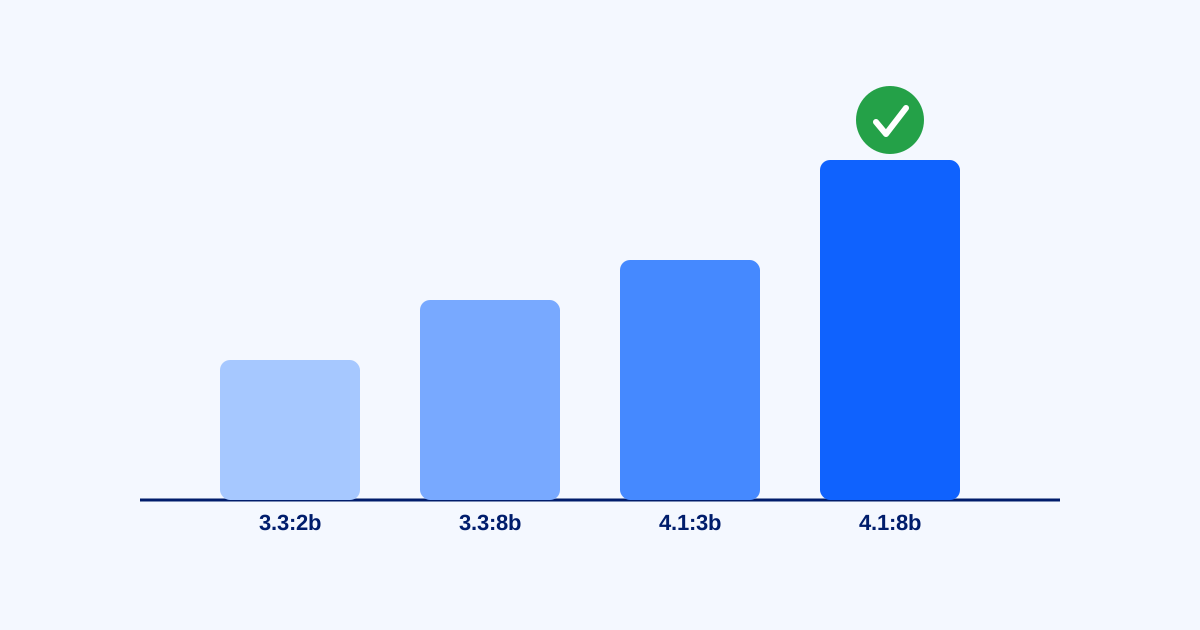
The differences appeared in output quality and reliability. granite3.3:2b encountered a JSON parse failure on layer 2 because it included bullet points inside a JSON string value, breaking the pipeline. granite3.3:8b and granite4.1:3b both produced clean, readable outputs. granite4.1:8b stood out with the most specific recommended actions: concrete steps like waiting 30 minutes before checking coolant and locating the MIN/MAX marks on the reservoir.
granite3.3:2b broke the pipeline by embedding bullet points inside a JSON string value on layer 2 — a reminder that smaller models need stricter output-format guardrails before they can be trusted in production.
The Decision
Decision: granite4.1:8b is selected as our primary model, with granite4.1:3b retained as a fallback if speed or hardware constraints become a factor.
The full evaluation results and scoring rationale are documented in ADR 302 in our repository.
For production delivery, we will transition from Ollama local inference to IBM watsonx.ai using the equivalent Granite 4.1 8B instruct model.
What This Means for the Project
Having a confirmed model means the rest of the report layer can now be built with confidence. Our three-scenario comparison across typical, atypical, and contradictory fault cases is the next step, using granite4.1:8b as the confirmed model.